1Accelerated schedule is per 12-month period, assumes completion of 3 semesters, enrollment in 12-18 credit hours per semester and continuous, full-time, year-round enrollment with no breaks. Normal schedule is per 12-month period, assumes completion of 2 semesters and full-time enrollment in 12-18 credit hours per semester.


Have a question?
Chat with a live agent now.
Need help?
 No thanks
Health Information Technology
Associate Degree Specialization in Health Information
Take your medical coding skills to the next level with an online health information degree specialization
Whether you’ve already earned an undergraduate certificate in medical billing and coding or you’re just getting started on your education path, our Associate in Health Information Technology program with a Health Information Degree Specialization can help you take the next step toward pursuing the career you want. In addition to building your knowledge of the ICD and CPT coding systems, our experienced professors will help you develop a thorough understanding of health services, the ethical and legal aspects of healthcare, healthcare statistics, information systems, and today’s regulatory requirements.
Get to know our Health Information Degree Specialization
Prepare for industry certification, showcase your skills to employers, and enjoy a complementary course with our health information specialization.
Built-in RHIT exam preparation
As a student in this program, you’ll prepare for AHIMA's Registered Health Information Technician (RHIT) certification exam with the RHIT Exam Preparation course. This course targets knowledge in the 6 competency domains tested on the exam using weekly domain exams and a final RHIT mock exam. Once you’ve satisfactorily completed this course with a grade of 85% or higher, we'll cover your fee for 1 RHIT exam attempt.
Complimentary course and AHIMA student membership
Here at DeVry, we want you to be ready to pursue the next steps in your career journey. That’s why your curriculum includes our complimentary Health Information Technology Mastery course, aligned with current CAHIIM requirements.
In this specialization, you’ll also receive a complimentary AHIMA student membership to help you tap into the industry, network with peers, and explore what’s next for your career.
Digital badge to showcase your AI skills
When you complete our Fundamentals of AI in Healthcare course, you’ll receive a digital badge to display on your resume and LinkedIn profile, signaling to employers that you’ve developed critical artificial intelligence skills that are shaping the future of health information technology.
Degree acceleration
Ready to get on the fast track toward your future? Here at DeVry, you can earn your Associate in Health Information Technology with a Health Information Specialization in as little as 1 year and 4 months on an accelerated schedule or follow a normal schedule and complete your program in 2 years.1
Classes start on October 26, 2026
Apply at no cost when you submit your application for our October 26 session.*
*Available to qualifying students who apply via phone with an Admissions rep.
Why DeVry?
Achieve your goals at DeVry
Get on the path toward graduation with a university focused on your success. At DeVry, we offer:
100% online program options
Flexible, around-the-clock access to 24/7 tutoring resources, an e-library, and our convenient mobile app
Wellness resources, such as confidential mental health support and counseling
Stackable program options that allow you to apply the qualifying credits you earn now toward a related future program here at DeVry2
Dedicated Career Services and Student Support advisors to help you pursue your goals
Knowledge & skills
What you'll learn
Our Associate Degree Program in Health Information Technology with a Health Information Degree Specialization covers the following topics and more:
International Classification of Diseases (ICD) coding
Current Procedural Terminology (CPT) coding
Artificial intelligence in healthcare
Health information technology
Medical terminology
Medical records and health information management
Digital Health Core — curriculum designed for today’s digital health careers
As a Health Information Technology student, you’ll develop essential skills through a series of dynamic courses we call our Digital Health Core. You’ll explore principles used throughout the healthcare ecosystem in topics like medical terminology, compliance, ethics, electronic medical records, patient privacy, and the digital and data-driven technologies that support healthcare delivery. You’ll also build experience with artificial intelligence in healthcare settings.
Accreditation matters
Being accredited means we’ve met rigorous quality standards and are committed to giving you the education you deserve. Our accreditations and recognitions include:

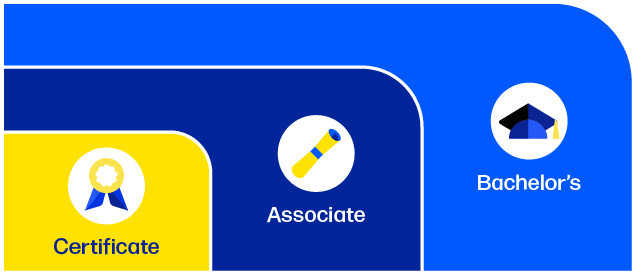
If you’ve already earned an Undergraduate Certificate in Medical Billing and Coding here at DeVry, many of the courses you completed can be applied toward your Associate in Health Information Technology with a Health Information Specialization. After earning your associate degree, eligible coursework applies toward our Bachelor’s in Technical Management with a Specialization in Health Information Management. Build your future one step at a time here at DeVry.2
Careers
Career opportunities with a health information degree specialization
When you earn our Associate in Health Information Technology with a Specialization in Health Information, you can consider careers including:
Program courses
Health information degree specialization courses
In this specialization, you’ll explore a variety of online health information classes that cover medical billing and coding knowledge related to ICD and CPT, health information technology concepts, and various general education and essential healthcare topics.
Health information coursework preview
Here are just a few of the health information classes you’ll explore as a student in this program:
CPT Coding with Application
This course introduces you to the principles of Current Procedural Terminology (CPT), which is used to code procedures and services performed by healthcare providers. Through practice exercises, you will assign appropriate CPT codes and applicable modifiers as needed.
Fundamentals of AI in Healthcare
This course prepares you for the future of health information technology with foundational learning and hands-on experience with AI tools that are influencing the day-to-day realities of healthcare administration. Upon completion of this course, you’ll receive a digital badge to display on your resume and LinkedIn profile and demonstrate your applied AI skills to employers.
Health Information Practicum and RHIT Exam Preparation
This course prepares you for the Registered Health Information Technician (RHIT) certification exam, which assesses aptitude in 6 competency domains:
You will complete weekly domain exams and a final RHIT mock exam. If you pass the course with an 85% or better, we’ll provide a complimentary voucher to cover the RHIT exam fee.
Health Information Technology Mastery
This course — provided to you at no additional tuition cost — aligns with the latest CAHIIM guidelines to help ensure you’re learning industry-relevant skills that prepare you for a career path in health information technology.
ICD Coding II with Application
The second in a 2-course sequence, this class addresses principles, guidelines, definitions, and coding conventions of the International Classification of Diseases, 10th Revision, Procedural Coding System (ICD-10-PCS). Coursework helps you gain the experience needed to accurately decipher operative statements and build codes in ICD-10-PCS.
Medical Ethics, Compliance, and Patient Privacy
Examine legal and regulatory issues in healthcare, emphasizing their application in ethical practices, compliance, and patient privacy. Explore rights and responsibilities of providers, employees, payers, and patients in a healthcare context. Laws and regulations addressing information release and records retention are examined, as are legal and regulatory issues surrounding information confidentiality.
Frequently asked questions
What is a health information degree?
What is the difference between health information and medical records?
What certifications can health information specialists earn?
How do healthcare facilities use health information specialists?
What skills are essential for health information management?
What career advancement is available in health information?
How much training is needed to become a health information specialist?
Is health information a good career path?
Is health information technology different from informatics?
How do I apply to DeVry?
2025-2026 academic catalog
View academic catalog
Related programs


Accreditation and related information
The Health Information Management accreditor of DeVry University is the Commission on Accreditation for Health Informatics and Information Management Education (CAHIIM). The University’s accreditation for the Associate degree program in Health Information Technology (HIT) has been reaffirmed through 2032-2033. All inquiries about the program’s accreditation status should be directed by mail to CAHIIM, 200 E. Randolph St., Ste. 5100, Chicago, IL, 60601; by phone at 312.235.3255; or by email at info@cahiim.org.
As reported on DeVry University’s 2024 CAHIIM Annual Program Assessment Reports, HIT program graduates who were eligible for, and chose to sit for, the Registered Health Information Technician (RHIT) certification exam had a 66% pass rate for first time test takers in academic year 2023-2024.
Graduation rates for all new full-time students, including transfers, for fall cohorts were: 2008 37%, 2009 34%, 2010 34%, 2011 28%, 2012 33%, 2013 32%, 2014 27%, 2015 36%, 2016 42%, 2017 49% and 2018 47%.
Retention rates for all first-time freshmen, including new transfers, for fall cohorts were: 2014 40%, 2015 54%, 2016 46%, 2017 62%, 2018 63%, 2019 58%, 2020 52%, 2021 56%, 2022 62%, and 2023 62%.
Timeframes, definitions and calculations
The outcomes below were reported to CAHIIM in June 2025. CAHIIM required only summary data for graduates. A placement rate was not reported. Data was reported for all students who graduated between 7/1/2023 and 6/30/2024.
In-field and out-of-field employment includes new employment obtained within a year after graduation. “New employment” is defined as employment obtained no earlier than 6 months prior to graduation. “Existing employment” is defined as employment that existed at the time of enrollment or was obtained more than 6 months prior to graduation.
| Timeframes, definitions and calculations | |||||||
|---|---|---|---|---|---|---|---|
| Location | Program | Number of graduates | Number of graduates employed within one year | Number of graduates with new in-field employment | Number of graduates with new out-of-field employment | Number of graduates with existing in-field employment | Number of graduates pursuing further education |
| IL Online | Associate in Health Information Technology | 402 | 60 | 24 | 36 | 22 | 0 |
Note: DeVry University is required to report employment data to CAHIIM. DeVry University does not guarantee employment. Readers should not make assumptions about their own likelihood of employment based on this data. Attempts were made to obtain employment status information for all graduates. Collected data includes, but is not limited to, the intent to work in a field-related position and, for those who are so employed, the graduate’s start date, title, employer name, duties, hours worked per week and earnings. Information was gathered through a variety of means. Generally, information was gathered from forms graduates completed. Data may also have been collected through in-person, telephone or email interviews with graduates or from third-party sources. DeVry University neither verifies nor guarantees the accuracy of information gathered.
1Accelerated schedule is per 12-month period, assumes completion of 3 semesters, enrollment in 12-18 credit hours per semester, and continuous, full-time, year-round enrollment with no breaks. Normal schedule is per 12-month period, assumes completion of 2 semesters and full-time enrollment in 12-18 credit hours per semester.
2At the time of application to the next credential level, an evaluation of qualifying transfer credit will occur and the most beneficial outcome will be applied. Future programmatic changes could impact the application of credits to a future program at DeVry. Refer to the academic catalog for details.
3The Health Information Management and Health Informatics accreditor of DeVry University is the Commission on Accreditation for Health Informatics and Information Management Education (CAHIIM). The University’s accreditation for the associate degree in Health Information Technology has been reaffirmed through 2032-2033. The University’s accreditation for the bachelor’s degree in Technical Management with Health Information Management Specialty has been reaffirmed through 2029-2030. All inquiries about the programs’ accreditation status should be directed by mail to CAHIIM, 200 E. Randolph St., Ste. 5100, Chicago, IL 60601; by phone at 312.235.3255; or by email at info@cahiim.org.
4For the MBC certificate program, all but one course stacks into our Associate of Applied Science in Health Information Technology. For the MBC-HIC undergraduate certificate program, all but three courses stack into our Associate of Applied Science in Health Information Technology. For the AHIT program, all but three courses stack into our Bachelor of Science in Technical Management with a Specialization in Health Information Management. Program availability varies by location.
5Employment in this occupation may require years of relevant experience.



