X

hi
Have a question?

Chat with a live agent now.

Need help?

XNo thanks

Information Technology and Networking

Bachelor’s Degree Specialization in Mobile and Networked Devices

Let's get connected

Smart devices are all around us. From fridges that display the weather to light bulbs that turn on with a voice command, it’s possible to turn anything into a smart device thanks to the Internet of Things (IoT).

If you’re passionate about technology and fascinated by smart devices, earning a Mobile and Networked Devices Specialization at DeVry University is a great way to gather a unique perspective into this field. Build upon concepts you’ve learned in your Bachelor’s Degree in Information Technology and Networking program, like how devices connect, collect data, and talk to each other. Plus, gain career-relevant skills by integrating AI, machine learning, automation, and other technology to optimize your job performance.

Get to know our Mobile and Networked Devices Program Specialization

With this specialization, you’ll learn concepts and techniques to navigate information technology and mobility, networked devices and embedded systems, the ecosystem of the IoT, information security, and mobile devices.

Classes Start Every 8 Weeks


Minimum completion time1
2 years
8 months
OR
Normal completion time2
4 years

Accelerate at your pace

Choose the schedule that best fits your goals and commitments. You can earn your bachelor’s degree: 

  • In as little as 2 years and 8 months with an accelerated schedule1

  • More quickly with qualifying transfer credits

  • In 4 years with a normal schedule2 

1Minimum schedule does not include breaks and assumes 3 semesters of year-round, full-time enrollment in 12-18 credit hours a semester per 12-month period.

2Normal schedule does not include breaks and assumes 2 semesters of enrollment in 12-18 credit hours per semester per 12-month period.

Knowledge and skills

What you’ll learn

The Mobile and Networked Devices Specialization covers the following:

Network devices

Explore networked devices and programming techniques that make up operational terminal points. Learn about wired and wireless technologies, wearable computers that can access the internet, and small devices embedded in larger machines.

IoT systems

Explore digital concepts, devices, and connectivity within the realm of the Internet of Things (IoT). Learn the basics of networking, computing, and digital devices while deriving IoT solutions to solve problems.

Data analysis

Learn to draw conclusions by finding patterns and relationships in numerical data with tools used for statistical analysis. Find out how data analysis can be used to make more efficient databases.

Big data and wireless connectivity

Examine IoT architecture and analyze big data and wireless connectivity of machine-to-machine communication.

Stackable degrees

Demonstrate skills at every step

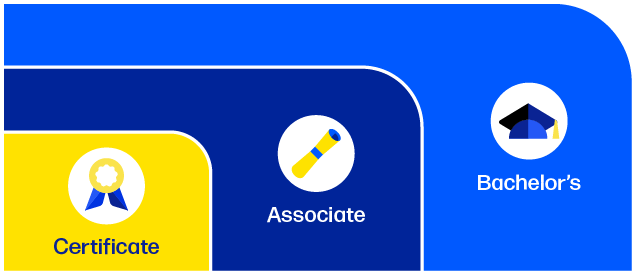
Our unique 3-in-1 design allows you to automatically earn an Undergraduate Certificate in Networking Essentials and an Associate in Information Technology and Networking,3 so you can boost your resume as you complete your Bachelor’s in Information Technology and Networking.

Accreditation matters

Being accredited means we’ve met rigorous quality standards and are committed to giving you the education you deserve. Our accreditations and recognitions include:

  • The Computing Accreditation Commission of ABET (CAC of ABET): Our Bachelor of Science in Information Technology and Networking is accredited by CAC of ABET, a global mark of quality that is respected by employers and professional associations within this field. 

  • The Higher Learning Commission (HLC): Institutionally, DeVry University is accredited by HLC, hlcommission.org. Our Keller Graduate School of Management is included in this accreditation.

Learn more about our
accreditations
Careers

Career opportunities in IoT mobile and networked devices

Graduates of our Mobile and Networked Devices Specialization may consider careers such as:

  • Computer and information systems manager

    Plan, direct, or coordinate activities in fields such as electronic data processing, information systems, systems analysis, and computer programming.

  • Computer systems analyst

    Work alongside engineers and developers to help build efficient computer elements into devices.

  • Computer system architect 

    Design and implement computer and information networks, such as local area networks (LAN), wide area network (WAN), intranets, extranets, and other data communications networks. Perform network modeling, analysis, and planning, including analysis of capacity needs for network infrastructures. 

  • Mobile and wireless device technologist 

    Build and maintain cell towers, creating wireless networks and fixing system, software, or hardware issues that arise.

  • Mobile device administrator 

    Administer, implement, support, and manage LAN and Voice over Internet Protocol (VoIP) networks and unified communications infrastructure while making recommendations for enhancements to ensure related systems are scalable and resilient.

  • Network and computer systems administrator

    Install, configure, and maintain an organization's LAN, WAN, data communications network, and operating systems, as well as physical and virtual servers.

Academic catalog
2025 - 2026 academic catalog
Program overview

1Minimum schedule does not include breaks and assumes 3 semesters of year-round, full-time enrollment in 12-18 credit hours a semester per 12-month period.

2Normal schedule does include breaks and assumes 2 semesters of enrollment in 12-18 credit hours per semester per 12-month period.

3At the time of application to the next credential level, an evaluation of qualifying transfer credit will occur, and the most beneficial outcome will be applied. Future programmatic changes could impact the application of credits to a future program. Refer to the academic catalog for details.

4Future programmatic changes could impact the ability to earn additional credentials en route to an eligible degree program at DeVry. Refer to the academic catalog for details.