1Minimum completion time does not include breaks and assumes 3 semesters of year-round, full-time enrollment in 12-19 credit hours a semester per 12-month period.
2Normal completion time includes breaks and assumes 2 semesters of enrollment in 12-19 credit hours per semester per 12-month period.


Have a question?
Chat with a live agent now.
Need help?
 No thanks
Computer Information Systems
Bachelor's Degree Specialization in Cyber Security Programming
Develop your skills with our cyber security programming specialization
Are you interested in keeping businesses secure from cyber crimes and cyber attacks? Get started with a bachelor’s degree program specialization in cyber security programming. This specialization will help you develop an understanding of coding and learn industry-relevant languages like Python, C#, and Java. You’ll also develop AI-supported security skills through our artificial intelligence foundations courses, where you’ll learn Python automation, AI-assisted coding, and prompt engineering techniques to support threat analysis, secure coding workflows, and modern cyber defense practices.
You’ll participate in hands-on learning that will teach you important concepts you can apply in both physical and virtual environments. As you engage in these real-world exercises and projects, you’ll develop the skills needed to plan, implement, and monitor security solutions to protect data and networks and prevent future attacks.
Get to know our cyber security programming specialization
Our Bachelor’s in Computer Information Systems with a Cyber Security Programming Specialization prepares you to pursue a career in computer information systems, placing you at the forefront of technology innovation and business problem-solving, especially in the areas of cyber security programming, code security, and secure applications.
You’ll learn how to analyze threats, secure applications, and apply defensive programming methods used in today’s security operations environments. You’ll also see how AI-enabled tools can streamline secure coding tasks and support automated threat detection.
Accreditation matters
Being accredited means we’ve met rigorous quality standards and are committed to giving you the education you deserve. Our accreditations and recognitions include:

Classes start on October 26, 2026
Apply at no cost when you submit your application for our October 26 session.*
*Available to qualifying students who apply via phone with an Admissions rep.
Why DeVry?
Why choose cyber security programming at DeVry?
Work with modern security tools and platforms
Immerse yourself in secure coding and cyber defense environments using tools and technologies related to application security, cloud security, system vulnerabilities, and automated threat analysis.
Industry-aligned curriculum
Elements of this curriculum are aligned with industry certifications that can validate your knowledge to employers:
- Certified Information Systems Auditor (CISA)
- CompTIA CySA+
- CompTIA DataSys+
- EC-Council CEH (Certified Ethical Hacker)
Take your ambition to the next level with a cyber security scholars program that helps you build your network, boost your skills and pursue the career you want.
Learn more about
Future Cyber Defenders Scholars Program


Minimum Completion Time1

2 years
8 months


Normal Completion Time2
4 years
Accelerate on your schedule
Choose the schedule that best fits your goals and commitments. You can earn your bachelor's degree in as little as 2 years and 8 months.1
Or follow a normal schedule and complete your program in 4 years.2
Knowledge & skills
What you’ll learn
When you pursue a Cyber Security Programming Specialization here at DeVry, you’ll learn the following:
Secure coding and application security
AI-supported security skills
Data privacy and secure data handling
Information systems security planning and audit
Incident response and digital forensics
Embedded programs
Embedded programs — demonstrate skills at every step
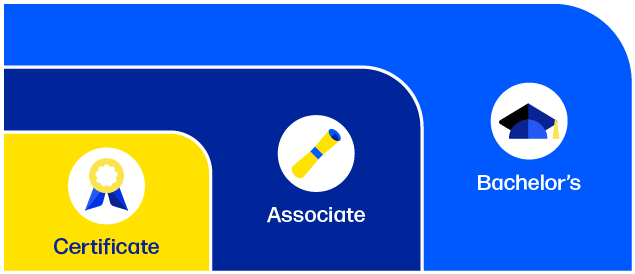
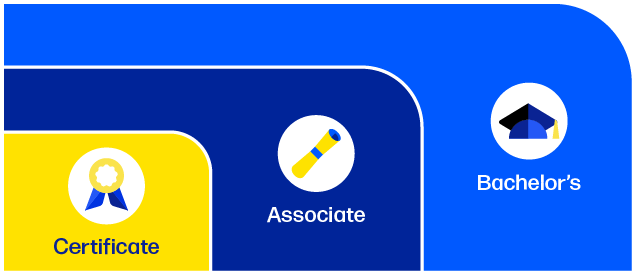
You can earn 2 additional credentials while earning your Bachelor’s in Computer Information Systems with a Cyber Security Programming Specialization.
Courses in our Undergraduate Certificate in Programming Essentials program and Associate in Information Technology and Networking are embedded in this program, allowing you the opportunity to earn a certificate and an associate degree on the road to your bachelor’s degree.3
Careers
Career opportunities in cyber security programming
With our Cyber Security Programming Specialization, you may consider the following careers:
Frequently asked questions
What programming languages does cyber security use?
Is cyber security programming hard to learn?
Is cyber security programming a good career?
2025-2026 academic catalog
View academic catalog
Related programs


1Minimum completion time does not include breaks and assumes 3 semesters of year-round, full-time enrollment in 12-19 credit hours a semester per 12-month period.
2Normal completion time includes breaks and assumes 2 semesters of enrollment in 12-19 credit hours per semester per 12-month period.
3Future programmatic changes could impact the ability to earn additional credentials enroute to an eligible degree program at DeVry. Refer to the academic catalog for details.



