
DeVry updates
By DeVry University
4 min read


Chat with a live agent now.
 No thanks


By DeVry University
4 min read
Please note: DeVry’s IoT kit has evolved; students no longer use a tangible take-home kit. You now have access to cloud-based IoT projects that make it easy to put theory into practice from anywhere. Want to learn more? Visit our Tech-empowered learning page.
Learning has become flexible in today’s world. That's why students in our technology programs have the ability to be hands on wherever they are, thanks to our take-home lab kit based on the Internet of Things (IoT).
“It gives students the ability to do their labs anytime, anywhere,” says James Karagiannes, Ph.D., professor and faculty chair in Engineering and Information Systems at DeVry and an integral member of the team that designed the kit. “It’s a big deal for our students because many of them are continuing their education, have been in the military and are coming back to train, or something like that. We have a lot of adult learners, many with full-time jobs. This is a more flexible, hands-on option for them.”
The kit is just one aspect of a sweeping overhaul to the tech curriculum, which includes Engineering Technology, Information Technology, and Software & Information Systems. The newly organized and designed courses build interdisciplinary skills for today’s IoT-based digital lifestyle.
The transformation is predicated around a curriculum that really matters in today’s workforce, according to William Phillips, Ph.D., associate national dean of Engineering & Information Systems, Health Sciences, and Media Arts & Technology.
“We picked one of the most obvious themes out there,” Phillips says. “It touches so many disciplinary fields, which our tech programs obviously do. Whether you’re talking about big data, cloud, mobile technology, or new and improved digital devices, it’s easy to add on to just about any discipline and make it fit into that scheme.”
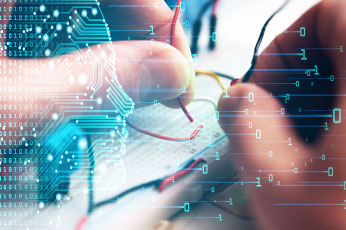
Mailed to students upon enrollment, our IoT Kit1 can’t help but bring back memories of Erector sets and engineering kits that many played with in their younger years. But, what’s in there is serious business and all about learning. It functions as a personal lab for students to physically practice the lessons they’re learning online and/or in the classroom.
“It’s basically a lab kit students would have and be able to use without depending on physical laboratories at a brick-and-mortar location,” Karagiannes says. “They have the kit throughout their time at DeVry and it has all the equipment they need to get hands-on in their courses.”
In their research, the team found that an increasing number of DeVry students are conducting their studies online. The goal: Design an equally good education experience for online and classroom learning, which the IoT Kit helps to accomplish.
“This is an opportunity for faculty and students to be on the same page and it helps deliver a more unified curriculum so that students aren’t getting variations between courses,” Karagiannes says. “We’re really happy with the way things have gone in terms of the kit we selected and how students are responding to it.”
How did creators decide what to put in the kit? “We looked at the different courses that were in the new tech curriculum and at what labs traditionally would be offered in these courses. How could they be modified and focused around a particular microprocessor or sensor?” Karagiannes says. “We aligned the curriculum to get a fixed number of devices so we’re course dependent, not curriculum dependent.”
Microprocessors, sensors, lights, a travel router for networking … there’s a lot going on in the kit and early testing with students has shown they use it both for school and for projects outside of their coursework.
“Once they learn to use the devices in there, they are very self-motivated to make up their own designs, create their own solutions, and explore additional possibilities,” Karagiannes says. The kit also creates savings for students who formerly needed access to a greater diversity of equipment. “We’ve taken those classes and designed labs around the kit that make use of it,” he continues. “We were able to narrow down what was going to be in the kit and come up with a really efficient way for students to have this laboratory environment at home.”
The IoT Kit puts real-world hardware in the hands of DeVry students, but an equally critical component is Microsoft Azure, a virtual system that allows students to work without fear of, well, messing things up. “It’s an independent platform that allows students to work on real software with a real server while not using their own computer, or one in a lab,” Karagiannes says. “They can mess up, then just reset and do it again without creating problems.”
Yet another way EIS students are offered flexibility in their academic pursuits: Our Undecided Option.2 Students taking this flexible academic route will choose a learning path after earning 30 academic credits. It’s basically a chance to get their feet wet while gaining knowledge they’ll need whatever degree they ultimately decide to pursue.
2The Portable IoT Kit is a required expense and is not complimentary.
2Must declare a specialization by 30 credit hours for associate degree programs and 60 credit hours for bachelor’s degree programs.
Filter blog post category



